I like this outfit beacuse this costume even though it was not sewn by me. Only my shoes were bought for the occasion. My hat I made myself and think about the remodeling. Of course I think about to I am thinking of using some clothes from this period - is will be very inspirational for me. For complete Im wearing (but not have on the picture) small hand bag and a gloves. Colors of my outfit is blue, white, gray and brown - colours refer to the see theme. More photos you can see here.
1930
I like this outfit beacuse this costume even though it was not sewn by me. Only my shoes were bought for the occasion. My hat I made myself and think about the remodeling. Of course I think about to I am thinking of using some clothes from this period - is will be very inspirational for me. For complete Im wearing (but not have on the picture) small hand bag and a gloves. Colors of my outfit is blue, white, gray and brown - colours refer to the see theme. More photos you can see here.
Sleeves
Bertha process

Process technique of bertha, on the left bertha dress from Hermitage, on the right berta of wedding dress from Met Museum
Sleeves, Metropolitan Museum of ArtSome days ago I finish a bertha for dress and now I working with sleeves pattern. I study some egxamples dress with bertha, but only dating around 1840. Bertha of this time is different from later exaples. They are widespread and sewing together with the front seam. I used technique described by Janet Arnold in her excellent book Patterns of Fashion 1 from page 66. Now I working with sleeves. I choose pattern from dress Met Museum. Bertha is quite different from Hermitage dress, the crossway pleats are from top to bottom, but in my pattern - from bottom to top. The neckline I sew like from Hermitage dress, it is deeper and giving slender line
Skończyłam szycie berty. Technika nie jest skomplikowana ale wymaga cierpliwości, wykorzystałam opis konstrukcji z książki J. Arnold Patterns of Fashions 1. Bazą jest bawełna na którą przyszłam 9 tasiemek ze skosu odpowiednio je układając oraz trzymając się kierunku wątku. Tasiemki berthy mogą być dwojako ułożone albo szyto je z góry na dól lub odwrotnie. Tasiemki mojej berthy układają się z dołu do góry. Następnie zszyłam dwie połowki i przyszyłam do stanika sukni z przodu a teraz czas na modelowanie rękawów.


Dziś byłam na corocznej wystawie związanej z haftem i robótkami ręcznymi. Na wystawie można zobaczyć haftowane obrazy o tematyce kwiatowej, także samplery ( jak to nazwać po polsku nie wiem) oraz ciekawe propozycje o tematyce dziecięcej. Było kilka stoisk w tym zachwyciło mnie stoisko z hiszpańskimi bawełnianymi koronkami firmy IEMESA z Barcelony. Kupić nic nie można było, ale za to udało mi się nabyć nowy katalog DMC na 2012 rok oraz broszurkę o hardangerze. Wystawę polecam chociaż jej rozmiary są bardzo skromne w porównaniu z wystawami we Francji, w Anglii czy w Rosji.
Von Unterschiedlichen Täntzen - 3rd Rothenfels Dance Symposium 2012

In June I’m going to 3rd Rothenfelts Dance Symposium 2012 and I’ll be there present my lecture: Von Unterschiedlischen Tӓntzen – Diary of Georg Schroeder and the tradition of dance culture in the second half in the 17th century. Small excerpt from my lecture:
„It is a diary of a Gdansk councillor Georg Schroeder (1635 – 1703). He was a true renaissance man. In this diary he wrote about different dances, which he saw and probably danced. Gdańsk was a famous city, known from the dance culture – expecially from luxurious balls, festivities and events – like big festivities for Polish kings and queens with performances of elaborated moresques by the guilds of furriers, sailors and others.(...)
The manuscript is illustrated with schematic drawings of these dances which were very popular among in the wealthy patricians and lower classes in Gdansk. Lessons of dance were present in education in Gdańsk and even the Jesuit schools had dance lessons for children of wealthy patricians and Polish magnates in their system of education. This was mentioned some years later in a big work of Gottfried Taubert Rechtschaffener Tanzmeister.
My and many interesting lectures about dance will be present during Symposium in Rothenfelts in 6 - 10 June 2012.
Some old parasols
Last week I found four old parasols. I was looking for a long time frame of the umbrella that I could use for my costumes especially form 18/19th century. So I find one parasol with a very good condition, even the canopy of parasol has a small holes, it not to difficult for repair. I think that parasol is dated about 1890/1900. The handle was made from metal and wood, the canopy is made from green-gray silk.

W ostatnich tygodniach udało mi się zdobyć kilka parasoli. Zależało mi na strych mocnych metalowych stelażach i ładnych rączkach. Kilka lat szukania i nagle w jednym tygodniu takie zdobycze. Pierwszy parasol datuje na wczesną secesję i jest to parasol na deszcz nie przeciw słoneczny. Nie zniszczony przez czas, również jego oryginalne pokrycie jest w stanie prawie nienaruszonym a małe dziurki z łatwością można zamaskować. Drugi parasol wymaga naprawy poszycia, więc czas na szukanie odpowiedniego jedwabiu, szkielet jest w stanie nienaruszonym. Trzeci parasol jest wyjątkowy pomimo że nie zachował się materiał. Jest typowy parasol z czasów Art Deco, na co wskazuje ozdobna rączka z drewna i winno-czerwonego bakelitu. Stelaż naruszony brakuje w nim dwóch promieni i trzeba będzie je naprawić. Czwarty parasol jest typowym chińskim parasolem letnim, pokrytym drukowanym papierem, trochę zniszczonym i wymagającym kilku napraw. Także nadającym się na czasy lat 20 stych i 30 stych XX wieku.
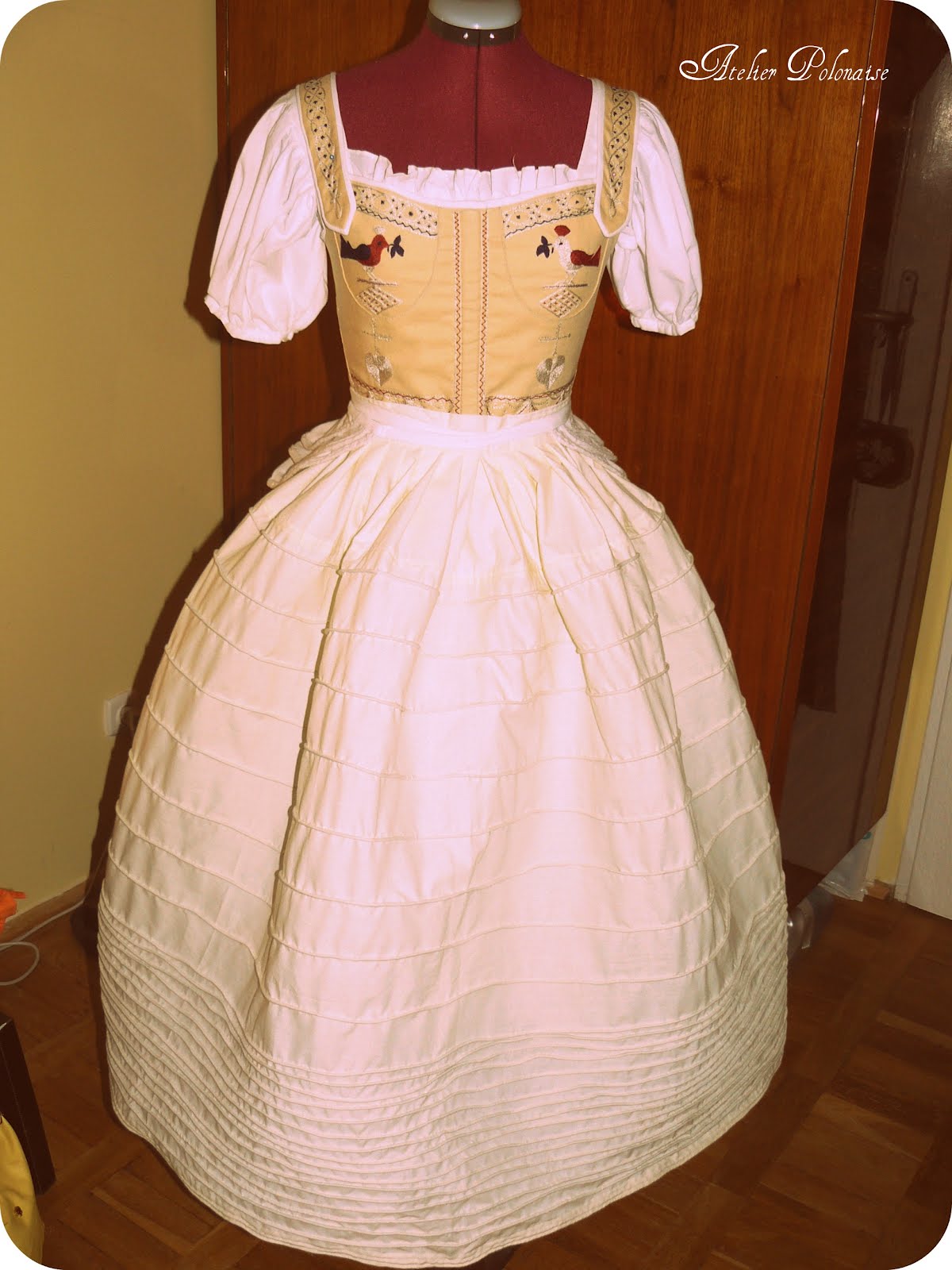
Bodice dress 1840


Corded petticoat
Wiener Moden


You can see Wiener Moden from Digital Library of Wielkopolska. Many fashion plates date 1816 - 1824.
What happen?
I spend there wonderful time and now I come back to my sewing business and dissertation.
But today I write about a new book (is only in Polish) but is very interesting.

Ewa Letkiewicz Klejnoty w osiemnastowiecznej Polsce* it is the sceond book of author about history of jewellery in Poland in 18th and early 19th century. Book has many colorful illustration. Author took about of research collected in eighteenth-century Poland and the functioning of the contemporary reality. Exploring the preserved remains of eighteenth-century gems, guided and visualized written sources, closer to a story that shows not only the richness and variety of materials, motifs, patterns, but also the effects of the collected induced, and the functions they fulfill in society and the private individual people.
Complementing the text with a lively narrative is a rich, carefully chosen iconography. Exploring the preserved remains of eighteenth-century gems, guided and visualized written sources, closer to a story that shows not only the richness and variety of materials, motifs, patterns, but also the effects of the collected induced, and the functions they fulfill in society and the private individual people. Book has an abstract in English.
* Ewa Letkiewicz
Klejnoty w osiemnastowiecznej Polsce
Wydawnictwo: UMCS, Lublin 2011
str. 480
Some news.


Now I have to work hard on my doctorate thesis, which I want to open in June this year. I also plan to sewing nad finish my 1840 dress and corded peticoat and to start with a new dress from en early 19th century.